| FCC Announces Agenda for October
31 Event |
|
10/24. The Federal Communications Commission (FCC) released the
agenda [PDF] for its event scheduled for Wednesday, October 31, 2007, titled
"Localism Hearing and Open Commission Meeting".
This event is scheduled for 9:00 AM on Wednesday, October 31, 2007,
which is also Halloween.
The FCC's recent events titled "Open Commission Meeting" have rarely
been held at the time announced by the FCC.
This event is scheduled to be held in the FCC's
Commission Meeting Room, Room TW-C305, 445 12th Street, SW, and to be webcast by the
FCC. The FCC does not always take up all of the items on its published program. The FCC
sometimes adds items to the program without providing the "one week" notice required
5 U.S.C. § 552b. The FCC usually does not release at its events copies of
the items that it adopts at its events.
Localism Hearing. The FCC's agenda states that it will hold a
"Localism Hearing". It states that "The purpose of the hearing is to gather
information from consumers, industry, civic organizations, and others on
broadcasters’ role in their local communities and proposed changes to our
rules." The agenda does not name any witnesses.
FCC Commissioners Michael Copps
and Jonathan Adelstein complained
about the short notice for the localism hearing. They wrote in a
release [PDF]
issued immediately after the FCC released its notice of the hearing that "This is
unacceptable and unfair to the public. And it makes putting together an expert panel nearly
impossible." The asked, "Is the Commission serious about allowing the public to
participate in the agency’s decisionmaking? Or is the goal to be able to claim that hearings
have been held, even if the public has not had a chance to fully participate?"
Regulation of Contracts with MDUs. The FCC's agenda states that the
FCC will adopt a Report and Order regarding "the use of exclusive contracts for
the provision of video services to multiple dwelling units ("MDUs") and other
real estate developments".
The FCC adopted its Notice of Proposed Rulemaking (NPRM) on March 22, 2007, and released the
text
[19 pages in PDF] on March 27. See, stories titled "FCC Adopts MDU Forced Access
NPRM" in TLJ Daily E-Mail Alert No. 1,556, March 26, 2007, and "FCC Releases MDU
NPRM" in TLJ Daily
E-Mail Alert No. 1,557, March 27, 2007. See also,
notice in the Federal Register, April 18, 2007, Vol. 72, No. 74, at Pages
19448-19453. This NPRM is FCC 07-33 in MB Docket No. 07-51.
The FCC wrote in its NPRM that "We tentatively conclude that the Commission
has authority to regulate exclusive contracts for the provision of video
services to MDUs or other real estate developments where we find that such
contracts may impede competition and impair deployment of those services."
However, FCC statutory authority in this area is limited. The FCC has no
authority to regulate the owners of MDUs. Nor does the Communications Act
expressly provide that the FCC can regulate cable companies' contracts with MDUs.
But then, the FCC does not always act within its statutory authority.
The FCC might assert authority under Subsection 628(b) of the Communications
Act, which is codified at
47 U.S.C. § 548(b). It provides that "It shall be unlawful for a cable
operator, a satellite cable programming vendor in which a cable operator has an
attributable interest, or a satellite broadcast programming vendor to engage in
unfair methods of competition or unfair or deceptive acts or practices, the
purpose or effect of which is to hinder significantly or to prevent any
multichannel video programming distributor from providing satellite cable
programming or satellite broadcast programming to subscribers or consumers."
Section 628(c) also gives the FCC authority to write implementing regulations.
The FCC might assert that sole provider clauses in contracts between cable
companies and MDUs are "unfair methods of competition". This interpretation
would entail construing Section 628 as a parallel Sherman Act, for the cable
industry, with the FCC, rather than the DOJ's Antitrust Division and the Federal
Trade Commission (FTC) as the antitrust enforcer.
The FCC does have a history of asserting antitrust authority in excess of its
statutory authority. The FCC's antitrust merger reviews are without statutory basis.
The FCC might also assert authority under Section 706, which is codified at
47 U.S.C. § 157, note. It states that the FCC and state regulators "shall
encourage the deployment on a reasonable and timely basis of advanced
telecommunications capability to all Americans (including, in particular,
elementary and secondary schools and classrooms) by utilizing, in a manner
consistent with the public interest, convenience, and necessity, price cap
regulation, regulatory forbearance, measures that promote competition in the
local telecommunications market, or other regulating methods that remove
barriers to infrastructure investment." (Parentheses in original.)
The FCC might also assert authority under Section 621, which is codified at
47 U.S.C. § 541. Subsection (a)(1) provides that "A franchising authority
may award, in accordance with the provisions of this subchapter, 1 or more
franchises within its jurisdiction; except that a franchising authority may not
grant an exclusive franchise and may not unreasonably refuse to award an
additional competitive franchise. Any applicant whose application for a second
franchise has been denied by a final decision of the franchising authority may
appeal such final decision pursuant to the provisions of section 555 of this
title for failure to comply with this subsection."
That is, the FCC might entertain the legal fiction that MDUs are governmental
franchising authorities for the purpose of regulating MDU contracts.
The FCC has a history of creative interpretation of Section 621. For example,
the FCC stretched the meaning of Section 621 in its December 2006 video
franchising order. See, stories titled "FCC Adopts Order Affecting Local
Franchising Authorities" and "Adelstein Opposes Franchising Order" Reaction to
FCC Franchising Order" in
TLJ Daily E-Mail
Alert No. 1,510, December 27, 2007. That Report and Order and Further Notice
of Proposed Rulemaking is FCC 06-180 in MB Docket 05-311.
FCC regulation of contracts with MDUs is opposed by cable companies, which
have already negotiated contracts with MDUs, and by the
National Cable and Telecommunications Association (NCTA).
FCC regulation of contracts with MDUs is supported by telecommunications
companies, such as Verizon, which are deploying competing video services, and
by the US Telecom. It is also supported
by the Consumer Federation of America (CFA), Consumers Union (CU), Public
Knowledge, and USPIRG
Verizon wrote last week that the FCC "should adopt a narrowly tailored rule that
prohibits video providers from entering into or enforcing exclusive access provisions for a
limited period of time to give video competition a chance to take hold, after which time these
rules should automatically sunset absent an affirmative finding by the Commission that they
should be extended." See, Verizon's
notice [PDF] of ex parte communication of October 24.
Verizon's service area includes the densely populated areas of the east coast where a
higher percentage of the population lives in MDUs.
On October 24, 2007, Sen. Hillary
Clinton (D-NY) sent a letter to the two Democratic Commissioners, Copps and
Adelstein. She wrote that "I understand that the Commission is considering
whether to limit the ability of cable operators to use exclusive access
arrangements with building owners to deny residents in multiple dwelling units (MDUs)
a choice of competing video services. As I have heard from many of my
constituents in New York about the need for consumer choice in their video and
broadband options, I hope that you will support a decision in this proceeding
that will bring the benefits of competition in terms of technology, choice, and
price to consumers who occupy such units in New York and elsewhere."
If the FCC does provide relief to the telcos that impairs contracts with MDUs,
its final order will be vulnerable under judicial review.
Other Items. The FCC's agenda states that the FCC will adopt a Second
Report and Order concerning "Section 621(a)(1)'s directive that local
franchising authorities not unreasonably refuse to award competitive franchises
and the application of the Commission's findings in the First Report and Order
to existing franchises." This proceeding is MB Docket No. 05-311.
The FCC's agenda states that the FCC will adopt a Notice of Proposed
Rulemaking (NPRM) regarding changes to its implementation of
47 U.S.C. § 224, which provides that the FCC "shall regulate the rates, terms, and
conditions for pole attachments". This item is in the FCC's proceedings numbered RM-11293
and RM-11303.
The FCC's agenda states that the FCC will adopt a Report and Order, Declaratory Ruling,
Order on Remand, and a NPRM regarding local number portability (LNP) and numbering requirements.
This item is in the FCC's proceedings numbers WC Docket No. 04-36 (the FCC's huge omnibus
IP-enabled services proceeding), CC Docket No. 95-116 (LNP proceeding), and CC Docket No.
99-200.
|
|
|
| Chris Cox Addresses Securities
Regulation and Government Owned Entities |
|
10/24. Chris Cox, Chairman of
the Securities and Exchange Commission (SEC), gave a
speech titled "'The
Role of Government in Markets" at Harvard University in Cambridge, Massachusetts.
It was a far ranging speech that touched on internet fraud, information
transparency, and government surveillance, among other issues.
Cox expressed concerns about both government owned or controlled corporations (GOCCs) and
sovereign wealth funds (SWFs). He said that the GOCC are proliferating because of
"semi-privatization of government enterprises in areas such as banking, oil and gas,
infrastructure, transportation, and real estate".
Cox said that two recent development are challenging securities regulation.
"First, the number of government-owned or controlled corporations in our public
markets, as well as their size, is growing. Second, the number and size of
government-owned commercial investment funds is on the rise." He termed
that later as "sovereign wealth funds". And, with the globalization of
investment that results from new information and communications technologies,
this may create problems for national securities regulators.
Cox offered no conclusions, and made no policy recommendations. Rather,
he raised a number of issues, some of which are technology related, such as:
- What is the ability of the SEC and foreign securities regulators to stop
internet based securities fraud that harms US investors when the perpetrators
are within a GOCC located abroad? Will the foreign securities regulator be
impartial?
- What is the ability of the SEC and foreign securities regulators to ensure
information transparency with respect to the publicly traded securities of
government owned entities? Will foreign regulators enforce transparency at
their own entities?
- What is the interplay of the conduct of foreign intelligence
surveillance, the performance of companies in the market, and the regulation of
securities markets? Will governments conduct and provide the fruits of
surveillance to their own entities?
The SEC regulates securities markets, to protect investors from fraud, and to
facilitate investment, among other things. The SEC also attempts to promote
transparency, which Cox described as "full and fair disclosure to all market
participants", so that ordinary investors are not "at an information
disadvantage". The SEC also has authority with respect to enforcement of the
Foreign Corrupt Practices Act. His comments focused on the possible impact of
GOCCs and SWFs on these areas of regulation.
He did not address the possible impact of GOCCs and SWFs on areas
of government regulation assigned to other government agencies. Other agencies
may have concerns. For example, the SEC is not responsible for threats to
national security posed by acquisition of interests in US companies by foreign
government or companies. This is primarily the responsibility of the
Committee on Foreign Investments in the US (CFIUS).
Nor is the SEC is not responsible for policy based export controls. This is
primarily the responsibility of the Department of Commerce's (DOC)
Bureau of Industry and Security (BIS).
Although, GOCCs and SWFs may invest in strategic US companies for the purpose
unrelated to maximizing returns to investors, such as acquiring technologies and
expertise.
Nor is the SEC responsible for electronic or other surveillance, in the US or
abroad, by the US or by other nations. However, Cox did discuss the interplay of
governments' surveillance and government owned entities.
Nor is the SEC responsible for trade policy. For example, it would be the
responsibility of the Office of the US Trade
Representative (OUSTR) and other agencies to address foreign SWFs that
invest in US financial services or telecommunications companies, while at the
same prohibiting or limiting investment in their own financial services or
telecommunications industries. However, Cox did state that SWFs might provoke
protectionist responses.
Which Nations? Cox did not mention any nations in his speech, other
than the US. He did not mention any government owned businesses. Nor did he
mention any SWF, other than the US Social Security Trust Fund, which he said
would become a SWF, if it were to invest in capital markets.
For example, he did not mention the state of Alaska's
Alaska
Permanent Fund Corporation, the Canadian province of Alberta's
Alberta
Heritage Savings Trust Fund, or Norway's Government Pension Fund of Norway.
These are all government owned investors that take government revenues from the
sale and export of oil and invest it in capital markets to maximize long term return for
the citizens of their states. Perhaps Cox is not too concerned about these SWFs.
Perhaps he is more concerned about other oil revenue funded SWFs, such as the
United Arab Emirates' Abu Dhabi Investment Authority (ADIA), Kuwait's Kuwait
Investment Authority, or those of Kazakhstan.
Perhaps he is even more concerned about SWFs of the People's Republic of
China (PRC). However, he did not say.
Pursuit of Internet Based Fraud. Cox addressed a problem that may
arise with the proliferation of publicly traded government owned or controlled
corporations.
He said that "Today, Internet fraud is on the rise, and the only way that our
government or any other can protect its citizens is to cooperate with other
nations. The perpetrators of fraud on the Internet aren't restrained by national
boundaries."
He asked rhetorically, "Will the high level of cooperation that we know from
experience is required in international cases be forthcoming if the foreign
government or an entity it controls is itself under suspicion?"
He also stated that "When the regulator and the regulated are one and the
same, deference to the government-owned industry can all too easily trump
vigorous and neutral enforcement."
Government Surveillance. Cox also addressed a number of issues that
may arise with the proliferation and growth of government owned commercial
investment funds, which he referred to as "sovereign wealth funds".
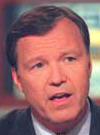 One of these pertains to surveillance and intelligence
operations. Cox (at left) said that "unlike private investors and businesses, the
world's governments have at their disposal the vast amounts of covert information
collection that are available through their national intelligence services." One of these pertains to surveillance and intelligence
operations. Cox (at left) said that "unlike private investors and businesses, the
world's governments have at their disposal the vast amounts of covert information
collection that are available through their national intelligence services."
He continued that "Current legal restrictions in some countries on the
domestic collection and use of such information might serve to protect the civil
liberties of that nation's citizens. But there are normally no concommitant
protections for foreign nationals, or for intelligence collection activities
conducted in other countries."
"Unchecked, this would be the ultimate insider trading tool", said Cox.
The SEC has authority with respect to securities fraud, and insider trading a
form of fraud. Cox did not discuss other uses of government surveillance, such
as theft of trade secrets, to benefit GOCCs or companies in which SWFs hold an
interest.
Cox did not discuss the extent to which government surveillance and intelligence agencies
might assist their domestic companies and investment funds in which they own no
interest.
Before his appointment to the SEC, Cox was a senior member of the House
Commerce Committee (HCC) and its Subcommittee on Telecommunications and the Internet,
where he developed expertise in policy areas related to information and
communications technologies.
Information Transparency. Cox said that "If ordinary investors -- an estimated
100 million retail customers who own more than $10 trillion in equities and stock funds in
U.S. markets -- come to believe that they are at an information disadvantage, confidence in
our capital markets could collapse, and along with it, the market itself. That’s why so much
of our effort is focused on full and fair disclosure to all market participants."
He continued that "Government ownership potentially threatens transparency, as well.
In many industrial countries today, the ability of journalists and citizens to inquire
into government affairs, or to criticize the conduct of government, is severely
limited. In some countries, criticism of government policies lands you in jail,
or worse. Is it reasonable to expect that these same governments will be
magically forthcoming with investors?
"The fact that minority shareholders in state-owned companies will be dependent on
the full disclosure of governments that are not subject to independent regulation raises
significant questions for regulators such as the SEC, whose mission includes investor
protection. And when it comes to transparency, the track record to date of most sovereign
wealth funds does not inspire confidence."
Enforcement Problems. Cox said that the SEC has authority to pursue
GOCCs and SWFs for violating US securities laws. The problem, he explained,
would be in the lack of cooperation from the foreign governments.
He said that "Neither international law nor the Foreign Sovereign Immunities Act
renders these funds immune from the jurisdiction of U.S. courts in connection with their
commercial activity conducted in the United States."
"But a discussion between the SEC and a foreign government might be quite
different if, instead of seeking cooperation in an enforcement matter in which
we were mutually interested, the SEC were pressing claims of insider trading
against that very government", said Cox.
"When a foreign private issuer is suspected of
violating U.S. securities laws, our experience working with our overseas
regulatory counterparts indicates that we could almost always expect the full
support of the foreign government in investigating the matter. But if the same
government from whom we sought assistance were also the controlling person
behind the entity under investigation, a considerable conflict of interest would
arise."
Protectionist Responses. Cox stated that "The rise of sovereign wealth funds
and state-owned public companies could even provoke a new round of protectionism, in which
various national governments erect barriers to foreign investment in what they consider to
be strategic sectors of their economies -- and in which the lines between restrictions on
foreign government ownership and foreign private ownership are dangerously blurred."
|
|
|
| People and Appointments |
|
10/26. The Senate confirmed Christopher Egan to be the Representative of the US
to the Organization for Economic Cooperation and
Development (OECD). See, Congressional Record, October 26, 2007, at Page S13495.
The Senate Foreign Relations Committee report lists the many large financial
contributions made by Egan or his relatives, mostly to Republican candidates and
committees, but also to a few Democrats and others, including Sen. Joe Lieberman
(D-MA, Rep. Mike Capuano (D-MA), Rep. David Obey (D-WI), and Ralph Nader. See,
Congressional Record, October 24, 2007, at Page S13362.
10/25. President Bush named Brian McCormack Deputy Assistant to the
President for Strategic Initiatives and External Affairs. He was Special
Assistant to the President and Deputy Director of the Office of Public Liaison.
Before that, he was Special Assistant to the Under Secretary for Acquisition,
Technology and Logistics at the Department of Defense. See, White House
release.
10/22. The National Telecommunications and
Information Administration (NTIA) published a
notice in the Federal Register that announces the new and existing members
of its National Telecommunications and Information Administration's Performance
Review Board. The members are Daniel Hurley (Director of the NTIA's
Communications and Information Infrastructure Assurance Program), Bernadette
Rivera (NTIA Associate Administrator for Telecommunications and Information
Applications), Renee Macklin (Chief Information Officer of the
International Trade Administration), Alan
Vincent (Associate Administrator for Telecommunications Sciences and
Director at the Institute for
Telecommunication Sciences), Michael Crison (National Oceanic and
Atmospheric Administration), and Karl Nebbia (Associate Administrator for
Spectrum Management at the NTIA). Macklin and Nebbia are new members. See,
Federal Register, October 22, 2007, Vol. 72, No. 203, at Page 59514.
10/18. Helane Morrison, the Securities
and Exchange Commission's (SEC) Regional Director in San Francisco, will
leave the SEC at the end of October. She will become General Counsel, Chief
Compliance Officer, and a Principal at
Hall Capital Partners. The SEC's San Francisco office is responsible for
northern California, Washington, Oregon, Montana, Idaho and Alaska. See, SEC
release.
|
|
|
| More News |
|
10/25. The Department of Justice's (DOJ)
Antitrust Division announced in a
release
that "it has closed its investigation of The Hearst Corporation's proposed
acquisition of a newly created ``tracking stock´´ of MediaNews Group Inc. (MNG). The
acquisition, which was revised in response to antitrust concerns raised by the
Department, would give Hearst approximately a 30 percent equity stake in MNG's
newspaper businesses outside of the San Francisco Bay Area". MNG owns, among
other things, the San Jose Mercury News.
10/25. The National Institute of Standards and
Technology's (NIST) Computer Security Division (CSD)
released its
DRAFT SP 800-39 [60 pages in PDF], titled "Managing Risk from Information Systems:
An Organizational Perspective". The deadline to submit comments is Friday, December
14, 2007.
10/25. The U.S. Patent and Trademark Office
(USPTO) published a
notice in the Federal Register that announces, describes and sets the comment deadline
(December 24, 2007) for, it proposal to amend the Rules of Practice in Trademark Cases,
at 37 CFR 2.37, to require a description of the mark in all applications to register a mark
not in standard characters. The notice states that this "will facilitate greater
accuracy and efficiency in design coding and in pseudo-mark data determinations. Therefore,
the revised rules will promote more accurate and complete searchability of marks in the USPTO
records. The current rule regarding descriptions of marks provides that a description ``may
be included in the application and must be included if required by the trademark examining attorney.´´"See, Federal Register, October 25, 2007, Vol. 72, No. 206,
at Pages 60609-60611.
10/25. The Government Accountability Office (GAO) released a
report [123 pages in PDF]
titled "Information Technology: Improvements for Acquisition of Customs Trade
Processing System Continue, but Further Efforts Needed to Avoid More Cost and
Schedule Shortfalls". This report pertains to the Department of Homeland
Security's (DHS) U.S. Customs and Border Protection's (CBP)
Automated Commercial Environment (ACE).
10/23. The Copyright Office (CO) published a
notice in the Federal Register that contains a final list of stations listed in
affidavits sent to the CO in which the owner or licensee of the station attests that the
station qualifies as a specialty station. The notice states that this list
"shall be used to verify the specialty station status of those stations identified as
such by cable systems on their semi-annual statements of account". The effective date
of this notice is January 1, 2008. See, Federal Register, October 23, 2007, Vol. 72, No. 204,
at Pages 60029-60030, and
17 U.S.C. § 111.
|
|
|
|
| Notice |
|
TLJ Daily E-Mail Alert No.
1,661, Wednesday, October 24, 2007, is now in the TLJ web site.
The e-mail servers of a few recipients blocked delivery. This issue contains articles titled
"Reps. Dingell and Markey Introduce Bill to End Deemed Granting of FCC Forbearance
Petitions", "6th Circuit Holds Unconstitutional Record Keeping Requirement for
Pornographers", "Rep. Hoyer Criticizes Bush Record on Surveillance",
and "Microsoft Capitulates to EC".
|
|
|
| Senate Intelligence Committee
Reports FISA Reform Bill |
|
10/26. Sen. Jay Rockefeller (D-WV)
introduced
S 2248 [61 pages in PDF], the "Foreign Intelligence Surveillance Act of
1978 Amendments Act of 2007". It was referred to the
Senate Intelligence Committee (SIC), which
reported it, on October 26, 2007. See,
Senate Report No.
110-209. This is the language approved by the SIC at its mark up session on
October 18, 2007.
|
|
|
Washington Tech Calendar
New items are highlighted in red. |
|
|
| Monday, October 29 |
|
The House will meet at 12:30 PM for
morning hour debate, and at 2:00 PM for legislative business. It will consider
non-technology related items under suspension of the rules. Votes will be
postponed until at least 6:30 PM. See, Majority Leader Hoyer's
weekly schedule and
schedule for October 29.
The Senate will meet at 3:00 PM.
It will resume consideration of S 294
[LOC |
WW],
the Amtrak Reauthorization bill.
8:30 AM - 6:30 PM. Day one of a five day course of instruction
hosted by Georgetown University Law Center titled "Georgetown Law -- Academy of WTO
Law and Policy". The price to attend is $2,700. For more information, call
Christine Washington at 202-662-4052. See,
seminar web site and
brochure
[PDF]. Location: Georgetown Law Gewirz Student Center, 12th Floor, 120 F St., NW.
10:00 AM. The Federal
Communications Commission's (FCC) and National
Telecommunications and Information Administration's (NTIA)
Joint Advisory Committee on Communications
Capabilities of Emergency Medical and Public Health Care Facilities will hold its first
meeting. See, FCC
Public Notice
[5 pages in PDF] (DA-07-4325). Location: FCC, Commission Meeting Room, TW-C305, 445 12th
St., SW.
Deadline to submit initial comments to the
Federal Communications Commission (FCC) in response to its
Further Notice of Proposed Rulemaking (FNPRM) regarding the roaming obligations of CRMS
providers. The FNPRM asks whether the FCC should extend roaming obligations
to broadband data services. The FCC adopted this item on August 7, 2007, and
released the text on August 16, 2007. It is FCC 07-143 in WT Docket No. 05-265. See,
notice in the Federal Register, August 30, 2007, Vol. 72, No. 168, at Pages
50085-50095. See also, story titled "FCC Adopts CMRS Roaming Order and NPRM"
in TLJ Daily E-Mail Alert No. 1,623, August 15, 2007.
Effective date of the Federal
Communications Commission's (FCC) rules changes regarding roaming obligations of CRMS
providers. These rules changes provide that CMRS carriers have roaming obligations as to
Title II services. The FCC adopted this item on August 7, 2007, and released the text
on August 16, 2007. It is FCC 07-143 in WT Docket No. 05-265. See,
notice in the Federal Register, August 30, 2007, Vol. 72, No. 168, at Pages
50085-50095. See also, story titled "FCC Adopts CMRS Roaming Order and NPRM"
in TLJ Daily E-Mail Alert No. 1,623, August 15, 2007.
|
|
|
| Tuesday, October 30 |
|
The House will meet at 9:00 AM for morning hour
debate, and at 10:00 AM for legislative business. See, Majority Leader Hoyer's
weekly calendar.
8:30 AM - 6:30 PM. Day two of a five day course of instruction hosted
by Georgetown University Law Center titled "Georgetown Law -- Academy of WTO Law
and Policy". The price to attend is $2,700. For more information, call Christine
Washington at 202-662-4052. See, seminar
web site and
brochure
[PDF]. Location: Georgetown Law Gewirz Student Center, 12th Floor, 120 F St., NW.
9:00 AM - 7:00 PM. The
Information Technology Association of America (ITAA)
will host its annual Chief Information Security Officers (CISO) Workshop. The speakers
will include Greg Garcia (Assistant Secretary, Office of Cyber Security and Communications,
Department of Homeland Security), Sherrill Nicely (Office of the Director of National
Intelligence), John Lee (Office of Management and Budget). Prices vary. See,
notice. Press contact:
Charlie Greenwald at 703-284-5305. Location: CSC, Executive Briefing Center, 3170 Fairview
Park Dr., Falls Church, VA.
9:30 AM. The U.S. International Trade
Commission (USITC) will hold a public hearing to assist it in preparing a report for
the House Ways and Means Committee regarding
government policies affecting trade with the People's Republic of China (PRC). The USITC
is examining, among other sectors, semiconductors and telecommunications. See,
notice in the Federal Register, July 31, 2007, Vol. 72, No. 146, at Pages
41773-41774, and USITC
release.
This proceeding is titled "China: Government Policies Affecting U.S. Trade in
Selected Sectors" and numbered Inv. No. 332-491. Location: USITC, 500 E
St., SW.
10:00 AM - 2:00 PM. The Free
State Foundation (FSF) and the Institute for Policy
Innovation (IPI) will host an event titled "The Federal Unbundling
Commission". The keynote speakers will be Sen.
Jim DeMint (R-SC), Rep. Marsha Blackburn
(R-TN), and FCC Commissioner Deborah
Tate. The other speakers will include Joe Waz (Comcast), Peter Davidson (Verizon), Rick
Whitt (Google), James
Gattuso (Heritage Foundation),
Robert Crandall (Brookings
Institution), Christopher Yoo
(University of Pennsylvania Law School),
Kevin Werbach (University
of Pennsylvania's Wharton School), and Tom Sugrue (T-Mobile). RSVP to Erin Fitch at erinfitch
at ipi dot org or 972-874-5139. Lunch will be served. Location: Room 2168 (Gold Room),
Rayburn Building, Capitol Hill.
10:30 AM. The
House Commerce Committee (HCC) will meet
to mark up numerous bills, including HR 3461
[LOC |
WW], the
"Safeguarding America’s Families by Enhancing and Reorganizing New and Efficient
Technologies Act of 2007", HR 2601
[LOC |
WW],
the "Do-Not-Call Registry Fee Extension Act of 2007", HR 3541
[LOC |
WW],
the "Do-Not-Call Improvement Act of 2007", HR 3526
[LOC |
WW], a bill to
include all banking agencies within the existing regulatory authority under the Federal
Trade Commission Act with respect to depository institutions, HR 3403
[LOC |
WW], the
"911 Modernization and Safety Act of 2007", and HR 3919
[LOC |
WW],
the "Broadband Census of America Act of 2007". This meeting
was previously scheduled for Thursday, October 25, 2007. The meeting will be
webcast by the HCC. Press contact: Brin Frazier, Carrie Annand or Lauren
Bloomberg at 202-225-5735. Location:
Room 2123, Rayburn Building.
12:30 NOON - 2:00 PM. The DC Bar
Association will host a program on the book titled
"
The Terror Presidency: Law and Judgment Inside the Bush Administration" [Amazon], by
Jack Goldsmith,
a former Assistant Attorney General in charge of the Office
of Legal Counsel. The book contains some material on the Foreign Intelligence Surveillance
Act (FISA) and the Terrorist Surveillance Program. The speakers will be Goldsmith, Stuart
Taylor (National Law Journal), Jeffrey Smith (Arnold & Porter), and Nancy Perkins (Arnold
& Porter). The price to attend ranges from $10 to $30. For more information, call
202-626-3463. See,
notice. Location: Arnold & Porter, 555 12th St., NW.
1:00 - 3:00 PM. The Architectural and Transportation Barriers Compliance
Board's (ATBCB) Telecommunications and Electronic and Information
Technology Advisory Committee (TEITAC) will meet by teleconference. The
conference phone number is 888-790-5019; the passcode is TEITAC. See, TEITAC
notice and
notice in the Federal Register, September 19, 2007, Vol. 72, No. 181, at
Page 53509.
2:00 PM. The House
Judiciary Committee's (HJC) Subcommittee on Courts, the Internet, and Intellectual
Property (SCIIP) will hold a hearing titled "Stifling or Stimulating -- The Role
of Gene Patents in Research and Genetic Testing". The
witnesses will be
Lawrence Sung (University of Maryland, School of Law),
Jonathan Soderstrom (Yale University Office of Cooperative Research), Marc
Grodman (Ch/CEO of Bio-Reference Laboratories), and
Jeffrey Kushan (Sidley
Austin). The hearing will be webcast by the HJC. See,
notice.
Location: Room 2141, Rayburn Building.
2:30 PM. The Senate Commerce
Committee (SCC) will meet to mark up several bills, including S 2096
[LOC |
WW],
the "Do-Not-Call Improvement Act of 2007", S 1853
[LOC |
WW],
the "Community Broadband Act of 2007", and S 1675
[LOC |
WW], the
"Local Community Radio Act of 2007". See,
notice. Location: Room 253, Russell Building.
6:00 - 8:15 PM. The Federal
Communications Bar Association's (FCBA) will host a seminar titled "Lobbying the
FCC and Congress: Ethical and Legal Considerations". The speakers will be
Kenneth Gross
(Skadden Arps), Jane Mago (National Association of
Broadcasters), and David Solomon
(Wilkinson Barker Knauer). The price to attend ranges from $25 to $135. Reservations and
cancellations are due by 12:00 NOON on October 26. See,
registration form [PDF].
This event qualifies for CLE credits. Location: Sidley
Austin, 6th Floor, 1501 K St., NW.
6:00 - 8:15 PM. The DC Bar
Association will host a continuing legal education (CLE) program titled "The
Ethics of E-Mail". The speaker will be Thomas Spann
(McGuire Woods). The price to
attend ranges from $80 to $115. For more information, call 202-626-3488. See,
notice. Location: DC Bar Conference Center, B-1 Level, 1250 H St., NW.
|
|
|
| Wednesday, October 31 |
|
The House will meet at 10:00 AM for legislative
business. See, Majority Leader Hoyer's
weekly calendar.
8:30 AM - 6:30 PM. Day three of a five day course of instruction hosted
by Georgetown University Law Center titled "Georgetown Law -- Academy of WTO Law
and Policy". The price to attend is $2,700. For more information, call Christine
Washington at 202-662-4052. See,
seminar web site and
brochure
[PDF]. Location: Georgetown Law Gewirz Student Center, 12th Floor, 120 F St., NW.
9:00 AM. The Federal Communications Commission (FCC)
may hold an event titled "Localism Hearing and Open Commission Meeting".
See, notice
[PDF]. Location: FCC, Commission Meeting Room (TW-C305 ), 445 12th St., SW.
9:00 AM - 4:30 PM. Day one of a two day meeting of
the Department of Homeland Security's (DHS)
Homeland Security Information Network Advisory Committee (HSINAC). See,
notice in the Federal Register, October 12, 2007, Vol. 72, No. 197, at
Pages 58108-58109, and Homeland Security Information Network (HSIN)
web
site. Location: Bolger Center, 9600 Newbridge Drive, Potomac, MD.
9:30 AM. The House Commerce
Committee's (HCC) Subcommittee on Telecommunications and the Internet will hold a hearing
on transition to digital television. See,
release.
The hearing will be webcast by the HCC. Location: Room 2123, Rayburn Building.
10:00 AM. The Senate Judiciary
Committee (SCC) will hold a hearing titled "FISA Amendments: How to Protect
Americans’ Security and Privacy and Preserve the Rule of Law and Government
Accountability". The witnesses will be
Kenneth Wainstein (Assistant Attorney
General in charge of the DOJ's National Security
Division), Ed Black (head of the Computer &
Communications Industry Association),
Patrick
Philbin (Kirkland & Ellis), and Morton Halperin (Soros's
Open Society Institute). See,
notice. Location: Room
226, Dirksen Building.
10:00 AM - 12:00 NOON. The House
Science Committee's (HSC) Subcommittee on Research and Science Education will hold a
hearing titled "Research on Environmental and Safety Impacts of Nanotechnology:
Current Status of Planning and Implementation under the National Nanotechnology
Initiative". The witnesses will be Clayton Teague (Director of the
National Nanotechnology Coordination
Office), Floyd Kvamme
(Co-Chair of the President’s Council of
Advisors on Science and Technology), Vicki Colvin
(International Council on Nanotechnology), Andrew Maynard
(Woodrow Wilson International Center for Scholars),
Richard Denison (Environmental Defense), Paul Ziegler (PPG Industries). The hearing will be
webcast by the HSC. Location: Room 2318, Rayburn Building.
2:00 PM. Two subcommittees of the
House Homeland Security Committee (HHSC) will hold
a hearing titled "Enhancing and Implementing the Cybersecurity Elements of the Sector
Specific Plans". The witnesses will be Greg Garcia (Assistant Secretary, DHS's
Office of Cyber Security and Telecommunication), David Powner (Government Accountability
Office), Michael Hickey (Communications Sector
Coordinating Council), George Hender (Options
Clearing Corporation),
Michael O'Hanlon (Brookings Institution), Larry Clinton
(Internet Security Alliance), Sally Katzen (George
Mason University School of Law),
Lawrence Gordon (University of
Maryland). This hearing will be webcast by the HHSC. Location: Room 311, Cannon
Building.
Deadline to submit comments to the National
Institute of Standards and Technology's (NIST) Computer
Security Division (CSD) regarding its
SP 800-110
[44 pages in PDF] titled "Draft Information System Security Reference Data
Model".
Deadline to submit applications to the
Department of Commerce's (DOC) Bureau of Industry and
Security's (BIS) Information Systems Technical Advisory Committee (ISTAC) to
participate by teleconference in its November 7, 2007, meeting. See,
notice in the Federal Register, October 23, 2007, Vol. 72, No. 204, at Page
60000.
|
|
|
| Thursday, November 1 |
|
The House will meet at 10:00 AM for legislative
business. See, Majority Leader Hoyer's
weekly calendar.
Day one of a two day conference hosted by the
Federal Trade Commission (FTC) titled "Ehavioral
Advertising: Tracking, Targeting, and Technology". See, FTC
release and
conference web site.
Location: FTC Conference Center, 601 New Jersey Ave., NW.
8:30 AM - 12:00 NOON. Day two of a two day meeting
of the Department of Homeland Security's
(DHS) Homeland Security Information Network Advisory Committee (HSINAC). See,
notice in the Federal Register, October 12, 2007, Vol. 72, No. 197, at
Pages 58108-58109, and Homeland Security Information Network (HSIN)
web
site. Location: Bolger Center, 9600 Newbridge Drive, Potomac, MD.
8:30 AM - 6:30 PM. Day four of a five day course of
instruction hosted by Georgetown University Law Center titled "Georgetown Law --
Academy of WTO Law and Policy". The price to attend is $2,700. For more information,
call Christine Washington at 202-662-4052. See,
seminar web site and
brochure
[PDF]. Location: Georgetown Law Gewirz Student Center, 12th Floor, 120 F St., NW.
10:00 AM. The Senate Judiciary
Committee (SJC) will hold an executive business meeting. The
agenda again includes
consideration of the nomination of
John Tinder
to be a Judge of the U.S. Court of Appeals
(7thCir). The agenda also includes consideration of S 2168
[LOC |
WW],
the "Identity Theft Enforcement and Restitution Act", and S 352
[LOC |
WW], the
"Sunshine in the Courtroom Act of 2007". See,
notice. The SJC rarely
follows its published agenda. Location: Room 226, Dirksen Building.
10:00 AM. The
House Small Business Committee will hold a hearing titled "Evaluating
the Impact of Pending Free Trade Agreements upon U.S. Small Businesses".
Location: Room 2360, Rayburn Building.
10:00 AM - 5:00 PM. Day one of a two day meeting of the
National Science Foundation's (NSF) Advisory Committee
for Cyberinfrastructure. See,
notice in the Federal Register, September 21, 2007, Vol. 72, No. 183, at
Pages 54079-54080. Location: NSF, 4201 Wilson Blvd., Room 375, Arlington, VA.
12:00 NOON. The
House Judiciary Committee's (HJC) Subcommittee
on Commercial and Administrative Law will hold a hearing on HR 3359
[LOC |
WW], the
"Mobile Workforce State Income Tax Fairness and Simplification Act of 2007".
The hearing will be webcast by the HJC. See,
notice.
Location: Room 2237, Rayburn Building.
Effective date of most of the U.S. Patent
and Trademark Office's (USPTO) changes to its Trademark Rules of Practice. These
rules changes require, among other things, plaintiffs in Trademark Trial and Appeal Board
(TTAB) inter partes proceedings to serve on defendants their complaints or claims, and to
utilize in TTAB inter partes proceedings a modified form of the disclosure practices
included in the Federal Rules of Civil Procedure (FRCP). These rules changes also delete
the option of making submissions to the TTAB in CD-ROM form. See,
notice in the Federal Register, August 1, 2007, Vol. 72, No. 147, at Pages
42241-42264.
Extended deadline to submit comments to the Department of Commerce's (DOC)
Bureau of Industry and Security (BIS) in response to
its Notice of Inquiry (NOI) regarding its Commerce Control List (CCL). See, original
notice in the Federal Register, July 17, 2007, Vol. 72, No. 136, at Pages
39052-39053, and revised
notice in the Federal Register, September 6, 2007, Vol. 72, No. 172, at
Pages 51213-51214.
Extended deadline to submit reply comments to the
Federal Communications Commission (FCC) regarding
ten studies related to government
regulation of media ownership. See, FCC
Public
Notice [4 pages in PDF], which is DA 07-3470 in MB Docket Nos. 06-121 and 02-277, and
MM Docket Nos. 01-235, 01-317, and 00-244, and
notice in the Federal Register, August 8, 2007, Vol. 72, No. 152, at Pages 44539-44540.
See also,
Public Notice [2 pages in PDF] (DA 07-4097) extending deadlines.
|
|
|
| Friday, November 2 |
|
Majority Leader Hoyer's
weekly calendar states that "no votes are expected in the House".
Day two of a two day conference hosted by the
Federal Trade Commission (FTC) titled
"Ehavioral Advertising: Tracking, Targeting, and Technology". See, FTC
release and
conference web site.
Location: FTC Conference Center, 601 New Jersey Ave., NW.
8:30 AM - 6:30 PM. Day five of a five day course of
instruction hosted by Georgetown University Law Center titled "Georgetown Law --
Academy of WTO Law and Policy". The price to attend is $2,700. For more information,
call Christine Washington at 202-662-4052. See,
seminar web site and
brochure
[PDF]. Location: Georgetown Law Gewirz Student Center, 12th Floor, 120 F St., NW.
8:00 AM - 1:00 PM. Day two of a two day meeting of the
National Science Foundation's (NSF) Advisory Committee
for Cyberinfrastructure. See,
notice in the Federal Register, September 21, 2007, Vol. 72, No. 183, at
Pages 54079-54080. Location: NSF, 4201 Wilson Blvd., Room 375, Arlington, VA.
9:00 AM - 4:00 PM. The Federal
Communications Commission's (FCC) Consumer Advisory
Committee will meet. See,
notice in the Federal Register, October 17, 2007, Vol. 72, No. 200, Page 58849-58850.
Location: FCC, Commission Meeting Room, Room TW-C305, 445 12th St., SW.
9:30 AM - 3:30 PM. The
Securities and Exchange Commission's (SEC) Advisory Committee Meeting
on Improvements to Financial Reporting will meet. Location: SEC
Auditorium, Room L-002, 100 F St., NE.
|
|
|
|
|
|
| Monday, November 5 |
|
2:00 - 3:30 PM. The U.S. Chamber
of Commerce's Coalition Against Counterfeiting and
Piracy (CACP) will meet. For more information, contact counterfeiting at uschamber dot
com or 202-463-5500. Location: U.S. Chamber, 1615 H St., NW.
2:00 PM. Deadline for petitioner (Quanta Computer) to file its
merits brief with the Supreme Court of the US
(SCUS) in Quanta Computer v. LG Electronics, a patent infringement case.
See, story titled "Supreme Court Grants Certiorari in Patent Exhaustion Case" in
TLJ Daily E-Mail Alert No. 1,647, September 27, 2007.
Deadline to submit initial comments to the
Federal Communications Commission (FCC) in response to
its Further Notice of Proposed Rulemaking (FNPRM) regarding potential interference unique
to the reverse band operating environment in the 17/24 GHz BSS. This FNPRM is FCC 07-76
in IB Docket No. 06-123. See,
notice in the Federal Register, August 22, 2007, Vol. 72, No. 162, at Pages
46939-46949.
|
|
|
| About Tech Law Journal |
Tech Law Journal publishes a free access web site and
subscription e-mail alert. The basic rate for a subscription
to the TLJ Daily E-Mail Alert is $250 per year. However, there
are discounts for subscribers with multiple recipients. Free one
month trial subscriptions are available. Also, free
subscriptions are available for journalists,
federal elected officials, and employees of the Congress, courts, and
executive branch. The TLJ web site is
free access. However, copies of the TLJ Daily E-Mail Alert are not
published in the web site until one month after writing. See, subscription
information page.
Contact: 202-364-8882.
P.O. Box 4851, Washington DC, 20008.

Privacy
Policy
Notices
& Disclaimers
Copyright 1998-2007
David Carney,
dba Tech Law Journal. All rights reserved. |
|
|