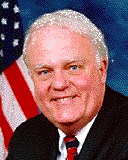
Sensenbrenner
Clinton Chief of Staff Criticizes GOP R&D Plans
(September 2, 1999) Bill Clinton's Chief of Staff, John Podesta, gave a speech in Washington on September 1 in which he criticized Republican budget and tax plans. He accused Congressional Republicans of slashing R&D. John Podesta's allegations are contradicted by Clinton administration testimony at a recent House Science Committee hearing on R&D funding. The speech also prompted Committee Chairman James Sensenbrenner to quip, "I am encouraged by the Administration’s sudden interest in science funding."
| See, Speech by John Podesta, National Press Club, 9/1/99. |
John Podesta told a gathering at the National Press Club on Wednesday, September 1, that, "The Administration is deeply concerned that the Republican-led Congress, particularly the House, is proposing to make deep cuts in our funding for research and development in the new fiscal year. Republicans in both the House and the Senate are proposing a risky tax and budget cuts that will guarantee that federal funding of R&D is slashed in the future. This is the wrong direction for our country. One wonders whether this Congress would have zeroed out Jefferson's request for the Lewis and Clark Expedition."
John Podesta concluded that "It appears that these Republicans grew up watching too much Fred Flintstone and not enough Jetsons."
|
|
| Rep. James Sensenbrenner |
Rep. James Sensenbrenner (R-WI) responded in a press release that, "In total, the Republican Congress has appropriated more for R&D than the Administration requested in three out of the last four years. Those in Congress who have been advocates of increasing science funding welcome the Administration to our cause. We hope, however, the President’s staff view science funding as a priority, not a short-lived political gimmick." (See, copy of press release at bottom of page.)
The House Science Committee's Subcommittee on Basic Research held a hearing on R&D funding on July 14, 1999. At issue was HR 2086, a bill sponsored by Rep. Sensenbrenner, and cosponsored by many members of the Committee from both parties.
Rep. Nick Smith (R-MI), the Chairman of the Subcommittee, presided at the hearing. He described the bill in his opening statement. He said that, "Overall, the bill authorizes a total of nearly $4.8 billion over five years for the agencies under the Science Committee’s jurisdiction. Its centerpiece is the Networking and Information Technology Research and Development program, which includes authorizations for individual or small-team grants; large grants of up to $1 million for long-term basic research; information technology research centers; terascale computing hardware; and for-credit university internship programs for research at private companies. In addition, the bill provides authorizations for the existing High Performance Computing and Communications programs and the completion of the Next Generation Internet program."
The bill would also make permanent the existing research and development tax credit. It would also fund a study of the availability of encryption products abroad.
Rep. Smith and other members of the subcommittee spoke in support of the bill. So did a group of witnesses from private industry and academia, which included Roberta Katz (President and CEO of Technology Network), Edward Lazowska (Professor and Chairman of the Department of Computer Science & Engineering, University of Washington, and Chairman of the Computing Research Association) and Alan Blatecky (Vice President for Information Technology, MCNC, Research Triangle Park).
However, one witness criticized the bill: Neal Lane, Assistant to the President for Science and Technology, and Director Office of Science and Technology Policy.
|
What They Said |
| Rep. Nick Smith Alan Blatecky Neal Lane Edward Lazowska |
Neal Lane testified at the hearing on behalf of the Clinton administration. He criticized the Congressional appropriations committees, criticized the encryption section of the bill, and said that the administration does not support the out-year funding levels contained in the bill.
Rep. Smith tried unsuccessfully to obtain a statement of support for the research and development funding levels contained in the bill from Neal Lane.
Rep. Smith asked Neal Lane if the "administration is prepared to support the increased funding in this bill for information technology. When you were here before the subcommittee earlier you indicated that the funding for the, the prospects for funding for out-years was flat as far as the discretionary funding -- does the administration prepared to support the increased funding for IT?"
Neal Lane obfuscated a negative reply. "Mr. Chairman, we certainly appreciate the statement of high priority for this important research area that is made by this projected out-year budget in the bill. The administration's position remains as it was before. We have bottom line constraint on out-years that is based on the agreement that the President has with the Congress. But, as I stated earlier, the out-year budget for any particular agency or any particular program is not specified as a matter of policy. I think these out year numbers, we expect to revisit, the budget each year as the President brings it forward, and I will continue to argue for strong funding for this particular initiative."
Yet, in spite of this testimony in July, Podesta described the Sensenbrenner bill as follows: "The Republican Chairman of the House Science Committee has introduced legislation that would authorize much of the Administration's information technology initiative."
John Podesta also stated that "I would hope that we can continue to
extend this partnership with the Congress across our entire science and
technology agenda - and promote private sector investment in research and
development by supporting the R&D tax credit." However, the
Sensenbrenner bill would go further, and make the R&D tax credit permanent.
| Press Release of Rep.
James Sensenbrenner (R-WI). Re: Reply to speech by John Podesta on R&D funding. Date: September 2, 1999. Source: House Science Committee. |
|
SENSENBRENNER STATEMENT ON PODESTA REMARKS WASHINGTON, D.C. – House Science Committee Chairman F. James Sensenbrenner, Jr., (R-WI) released the following statement today in response to remarks made on research and development (R&D) funding by White House Chief of Staff John Podesta yesterday at the National Press Club. "I am encouraged by the Administration’s sudden interest in science funding. Over the last seven years, overall science budgets, which include both defense and civilian R&D, when indexed for inflation, have been flat or decreasing. Science needs a boost. "Unfortunately, the President’s Fiscal Year 2000 (FY2000) budget depends on budgetary tricks such as tax hikes and user fees that will never be enacted. In fact, the House of Representatives defeated the President’s FY2000 budget request by a vote of 426-2 and the Senate defeated it 97-2. This gimmickry significantly overstates the amount of money that can be made available for R&D. "Now the President’s Chief of Staff is complaining about the levels of science funding, which a few short years ago the Administration thought too generous. Mr. Podesta claims that programs within the National Aeronautics and Space Administration (NASA) would be severely under-funded in the Congressional appropriation process. However, in the Administration’s FY1997 budget, Vice President Gore proposed a NASA budget of $11.6 billion for FY 2000, $1 billion below the House Appropriation Committee’s current recommendation. "Mr. Podesta also included in his list of grievances the lack of adequate funding for a new standards laboratory at the National Institute of Standards and Technology (NIST). Ironically, just two years ago, in its FY1998 budget request, the Administration proposed no funding for the construction of this important laboratory while Congress appropriated $78 million for it. "In total, the Republican Congress has appropriated more for R&D than the Administration requested in three out of the last four years. Those in Congress who have been advocates of increasing science funding welcome the Administration to our cause. We hope, however, the President’s staff view science funding as a priority, not a short-lived political gimmick." |