
Majority
Leader
Dick Armey
(R-TX)
House Republicans Announce E-Contract
(June 25, 1999) House Majority Leader Dick Armey and other Republican Representatives announced an "e-contract" on Wednesday, June 23. The document is a ten point plan for removing "the barriers to future innovation, competition, and growth" of high tech industry.
|
Majority |
Rep. Dick Armey (R-TX) was joined by
Republican Representatives who have been active on high tech issues. "We're
here to tell you that we believe a cutting edge society needs a cutting edge
agenda," said Rep. Armey. "We had the Contract With America to
address a broad range of concerns. And we think we need a Contract that
specifically addresses the concerns of high-tech America.
"That's why we are proposing the e-Contract, to
ensure that high-tech America has the freedom it needs to innovate, grow, expand
and imagine," said Rep. Armey. "The real high-tech heroes of the
legislative agenda of high tech America are the Members that will speak. We
decided to bring them together under the general rubric of the e-contract, so
that we can say to high tech America, 'Keep on innovating; keep on creating;
continue to invent; continue to share; and we will make sure that government
stays out of your way.'"
| Related Pages |
| E-Contract. |
| E-Contract web site. |
The other Representatives who participated in the e-contract event were Chris Cox (sponsor of the Internet Tax Freedom Act, which became law last year), David Dreier (Chairman of the Rules Committee, and one of the lead cosponsors of the Year 2000 litigation reform bill), Jennifer Dunn (Ways and Means Committee member), Bob Goodlatte (sponsor of the pro-encryption SAFE Act), Billy Tauzin (Chairman of the Telecom Subcommittee), and J.C. Watts (House Republican Conference Chairman).
| Ten Goals of the E-Contract |
|
Rep. Chris Cox (R-CA) spoke about the importance of not imposing discriminatory taxes the Internet. He also advocated passage of the Year 2000 litigation reform bill.
He also advocated passage of Rep. Goodlatte's SAFE Act (HR 850), which would relax encryption exports restraints, ban government mandated key escrow, and allow Americans to use any encryption products. Rep. Cox commented that some Chinese political dissents would be free men today if encryption software had been available to them.
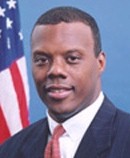
Rep. Watts (R-OK) stated that "Ronald Reagan said it very well when he said, 'government should work with people, not against them.' That is what the e-contract will do."
 |
|
| J.C. Watts |
"We want to take capitalism and opportunity into every pocket of poverty in America. And the electronic age -- the high tech age -- is presenting us with that opportunity," said Rep. Watts. "We will not take on the old guard attitude that says we must tax people more, we must litigate, and we must regulate people more."
"Government should not drive the high tech arena -- or regulation, or litigation, or taxation should not drive the high tech arena -- but technology should," concluded Rep. Watts.
Rep. Jennifer Dunn (R-WA) stated that "as a member of the Ways and Means Committee I am most focused on tax policy which encourages investment in the high tech industry. You see them pursuing tax credits that promote investment. Research and development are number one on our list of principles, as we write this e-contract."
 |
|
| Jennifer Dunn |
Rep. Dunn also promoted a bill that she and Rep. Bob Matsui (D-CA) "to phase out capital gains taxes on investments into companies that $300 Million or less in capitalized assets." She says that it will be "very useful to the high tech industry."
She also spoke about the extension of the R&D tax credit. "We will be doing this again this year. It will be in our tax bill that you will see very soon come out of the Ways and Means Committee."
However, Rep. Dunn did not use the words "permanent," or "permanently extend."
Rep. Dreier (R-CA) stated that "we as Republicans believe passionately in doing everything that we possibly can to provide for the free flow of goods, ideas, and services, and that is exactly what this agenda is doing."Rep. Dreier addressed making the R&D tax credit permanent. "As Jennifer Dunn went through talking about issues like dealing with the research and development tax credit, our goal of making that permanent. That can only happen when you make the macro commitment to reducing taxes. In the State of the Union Message that came from the President he was very clear in his opposition to any kind of tax reduction, for a decade and a half. But what we have said is that we as Republicans believe in reducing that tax burden. And until you take on that responsibility, which only the Republicans have, you cannot move to make the research and development tax credit permanent."
He also addressed H1B visas. "We need to deal right now with increasing the H1B visa level, and I am working with Senator Gramm on that once again, because we have already hit that cap."
Rep. Billy Tauzin (R-LA) (web site | bio) spoke philosophically about how the development of communications and information technology contributed to the fall of the Soviet system: it prevented governments from keeping their people ignorant.
He continued, "That is really the message of the e-contract. It says that this Republican majority is committed to all of the freedom inspiring, freedom enabling, freedom enriching aspects of high technology. It says that this Republican majority is determined to make sure that e-commerce is not taxed out of existence, nor regulated out of existence; that we are determined to make sure that people have the chance to have good encryption products, to have access to e-commerce that is secure, with privacy protected, where businesses and consumers can meet each other in this amazing world of digital services.
"It means that this Republican majority is committed to making sure that the incredible and freedom inspiring aspects of the Internet, merging with the old regulated systems of telephones and broadcast and cable, will not be subjected to that old, horrible, cholesterol riden, if you will, handicaps, of that regulated system. That is will not be burdened with all those regulations and subsidies. That instead the freedom inspiring aspects of Internet, with this wonderful digital age, will in fact be used to free up those regulated edges, and establish for Americans a marketplace where there is more and more choice, with more and more access, to more and more wonderful products ..."
Rep. Tauzin concluded that "This Republican majority is committing to making sure that this world of information, this world of freedom, is less litiguous, less regulated, than the old world we leave behind."
Rep. Goodlatte (R-VA) (web site | bio) stated that the free enterprise, low taxes, and less regulation that the Republican party stands for benefit the high tech economy.
The Congressional Republicans and Democrats are engaged in a dispute over which party is more pro high tech. Year 2000 litigation reform legislation is supported by the overwhelming majority of Republicans in the House and Senate, but opposed by many, but not all, Democrats. Republicans and Republican oriented interest groups have been citing this as evidence that Republicans are the party of high tech.
| Related Story: House Democrats form High Tech Advisory Group, 6/13/99. |
Earlier this month the House Democrats formed a High Tech Advisory Group. Rep. Anna Eshoo (D-CA) and Rep. Zoe Lofgren (D-CA) (web site | bio), two Silicon Valley Representatives, co-chair the group.
One Representative on the Advisory Group told Tech Law Journal that the Republicans e-contract is short on specifics. However, the Democratic group has yet to release any details regarding what bills, policies, or goals it will support.
| Related Story: Congressional Parties and High Tech, 1/5/99. |
The Tech Law Journal Congressional Scorecard 1998 rated all members of the House of Representatives on a 0 to 100 scale based on their performance in 1998. The criteria used were a roll call vote on the H1B visa bill, a roll call vote on the securities litigation reform bill, cosponsorship of the SAFE Act (encryption), cosponsorship of the Internet Tax Freedom Act, and membership in the Internet Caucus. On average, Republicans scored higher than Democrats.
|
Average High Tech Support Scores by Political
Party |
||
|
House |
Senate |
|
| Republicans | 60.18 (227) | 59.64 (55) |
| Democrats | 37.40 (208) | 35.56 (45) |
| Total | 49.29 (435) | 48.80 (100) |
Of course, many Democrats scored high. For example, both Rep. Eshoo and Rep. Lofgren both scored perfect 100s. Also, many Republicans scored low.